What Is CRPS, and Why Does It Hurt So Much?
Complex Regional Pain Syndrome (CRPS) isn’t just a bad injury that won’t heal. It’s your nervous system going haywire. One moment, you’ve got a sprained wrist or a broken ankle. The next, your skin feels like it’s on fire from a light touch. Your limb might swell, change color, or feel freezing cold-even though your body temperature is normal. This isn’t in your head. It’s your brain and spinal cord misreading signals, turning harmless sensations into agony.
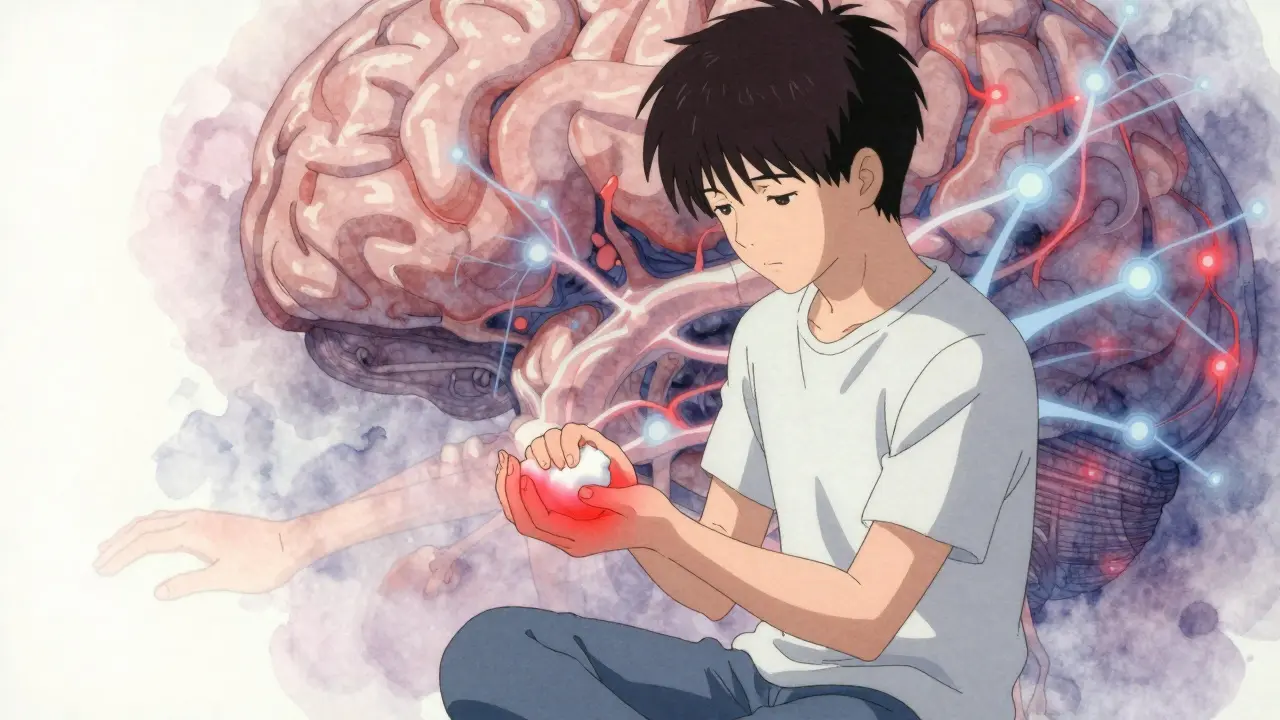
CRPS used to be called Reflex Sympathetic Dystrophy. Today, we know it’s not caused by damaged nerves alone. It’s a full-system glitch. The brain’s map of your body gets blurred. Areas meant to control your hand or foot start overlapping with neighboring regions. This is called cortical smudging. Your brain thinks your limb is under constant threat-even when it’s not. That’s why even a breeze or the weight of a blanket can feel unbearable.
Studies show CRPS affects about 26 in every 100,000 people each year, mostly after trauma or surgery. Around 70% of cases happen in people under 40. And while medications can help, they often don’t fix the core problem: your brain’s faulty wiring.
Desensitization Therapy: Rebooting Your Skin’s Alarm System
One of the first things you’ll notice with CRPS is allodynia-pain from things that shouldn’t hurt. A cotton ball feels like sandpaper. Your socks burn. Your shirt collar is torture. Desensitization therapy isn’t about toughing it out. It’s about gently retraining your nervous system to stop screaming danger.
The process starts absurdly simple. You use something softer than air-like a cotton ball or silk scarf. You touch your skin for just 5 minutes, 3 to 5 times a day. No pressure. No pain. If your pain score (on a scale of 0 to 10) goes above 3, you stop and try again tomorrow. Progress is measured in millimeters, not miles.
Over 4 to 12 weeks, you slowly move from cotton to silk, then to linen, denim, and finally, everyday clothing. Each step is only taken when your body says it’s ready. This isn’t a race. Rushing it makes things worse.
Why does this work? Brain scans show that after 8 weeks of consistent desensitization, the part of your brain that processes touch (the somatosensory cortex) calms down by 30-40%. Glial cells, which were stuck in overdrive, quiet down. Your spinal cord stops amplifying every signal. It’s not magic. It’s neuroplasticity-your brain rewiring itself, one gentle touch at a time.
Patients who stick with it report real wins: being able to wear socks again, sleeping without painkillers, or holding a coffee cup without flinching. One Reddit user shared, “After 3 months, my hand warmed up from 82°F to 96°F. I hadn’t felt normal warmth in 18 months.”
Graded Motor Imagery: Rewriting Your Brain’s Pain Code
If desensitization works on your skin, Graded Motor Imagery (GMI) works on your brain. Developed by Dr. G. Lorimer Moseley in the early 2000s, GMI is a three-step process designed to fix the distorted body map in your brain.
Stage 1: Left-Right Discrimination
You look at pictures of hands or feet-some left, some right-and you have to say which is which. Sounds easy? It’s not. People with CRPS often get this wrong. Why? Because their brain no longer recognizes the limb clearly. You start with 50 images a day. Your goal: 90% accuracy in under 1.5 seconds per image. Apps like Recognise Online help track progress. This isn’t a memory test. It’s a brain reboot.
Stage 2: Explicit Motor Imagery
Now you imagine moving your painful limb-without moving it. Picture yourself picking up a cup. Feel the weight. See your fingers curl. Do this for 5-10 minutes daily. No pain allowed. If it hurts, stop. The goal is to activate the brain’s movement areas without triggering the pain network. Over time, your brain learns that imagining movement doesn’t mean danger.
Stage 3: Mirror Therapy
This is the most visible part. You sit with a mirror between your arms. Your healthy hand moves in front of the mirror. Your painful hand hides behind it. Your brain sees the reflection and thinks the painful limb is moving smoothly and pain-free. After 6-12 weeks, this tricks your brain into believing the limb is safe again.
A 2006 study by Moseley found 70% of patients had over 50% pain reduction after just 4 weeks. Brain scans confirmed: the smudged areas in the somatosensory cortex shrank back to normal size. Tactile discrimination improved from 15.2mm to 6.8mm on two-point tests-meaning your brain could finally tell where you were being touched.

Why GMI Beats Traditional Physical Therapy
Traditional rehab for CRPS often focuses on stretching and moving the limb. But if your brain thinks movement equals pain, forcing it just makes things worse. Studies show standard therapy reduces pain by about 1.5 points on a 10-point scale. GMI? It knocks off 2.8 points on average.
A 2023 review of 33 clinical trials found GMI was far more effective than physical therapy alone. Patients didn’t just feel less pain-they moved better, slept better, and returned to daily tasks faster. Mirror therapy alone improved upper limb function by 40% compared to conventional rehab.
But GMI isn’t a magic bullet. It’s hard. The first two weeks are brutal. Pain spikes. Frustration builds. Many people quit. That’s why success depends on pacing, support, and professional guidance.
According to the Cochrane Review, only 65% of patients finish the full 6-month program. The key? Don’t rush. Let your brain lead.
What Happens When It’s Done Wrong?
Bad implementation is the #1 reason GMI fails. Pushing too fast? That’s how 15% of patients end up with worse pain. Skipping stages? You’re asking your brain to do a sprint before it’s learned to walk.
Therapists need special training. The American Physical Therapy Association says anyone delivering GMI should have at least 40 hours of CRPS-specific education. Certifications like the NOI Group’s Graded Motor Imagery course are the gold standard.
Common mistakes:
- Advancing stages too quickly (35% of failures)
- Not explaining the science to patients (28% of failures)
- Skipping psychological support (22% of failures)
CRPS isn’t just a physical problem. It’s a fear-based condition. If you’re not addressing anxiety, trauma, or catastrophizing thoughts, you’re only treating half the problem.

Success Stories and Real Numbers
When done right, the results are life-changing.
A 2023 survey of 1,200 CRPS patients found:
- 68% had meaningful pain reduction with GMI
- 42% cut their pain by more than half after 6 months
- 79% stuck with desensitization-higher than any other therapy
At the Cleveland Clinic, 83% of patients who started treatment within 3 months of symptoms saw major improvement. That number drops to 42% if they wait over a year. Time matters.
One YouTube creator, who’d been in pain for 4 years, said: “Weeks 1-2 were hell. My pain spiked 30%. But by week 6, I picked up a coffee cup. No screaming. No tears. Just coffee.”
Getting Started: What You Need to Know
You can’t do this alone. You need a therapist trained in CRPS rehabilitation-ideally one with CHT (Certified Hand Therapist) or CPP (Certified Pain Practitioner) credentials.
Here’s what to ask:
- Do you have formal training in Graded Motor Imagery?
- Can you show me your protocol for desensitization?
- Will you track my pain scores daily?
- Do you integrate psychological support?
Insurance coverage varies. In the UK, NHS England now mandates GMI access within 4 weeks of referral. In the US, 78% of academic medical centers offer it-but only 42% of rural clinics do.
Apps like Miro Therapeutics (FDA-cleared in 2022) now offer AI-guided GMI at home, improving adherence by 35%. They’re not a replacement for professional care, but they help bridge gaps.
Final Thoughts: Hope Is Real
CRPS doesn’t have to be a life sentence. Desensitization and Graded Motor Imagery aren’t experimental. They’re evidence-based, backed by brain scans, clinical trials, and thousands of real stories. They work because they target the real cause-not just the symptoms.
It’s slow. It’s frustrating. It’s not quick. But if you’re willing to show up every day-even when it hurts-you can retrain your brain. You can reclaim your body. And you can finally touch your skin without fear.