
What Exactly is a Cataract?
Your eye has a natural lens that focuses light onto the retina. Think of it as a clear, flexible camera lens. Over time, proteins in this lens begin to clump together, creating a cloudy area that blocks light from passing through clearly. This is what we call a cataract. It isn't a film over the eye, but rather a change in the lens itself. While age is the biggest driver, other factors can speed up the process. For instance, people with diabetes often develop cataracts earlier because high blood sugar can cause the lens to swell and cloud. Similarly, long-term use of steroid medications or a history of eye injuries can trigger the same protein breakdown. If left untreated, cataracts can eventually lead to total blindness, but the good news is that they are entirely treatable through surgical extraction.The Modern Way to Remove Cataracts
Gone are the days of "couching," an ancient and imprecise method of simply pushing the cloudy lens out of the way. Today, surgeons use a technique called phacoemulsification, which is used in about 95% of modern cases. Here is how the process actually works in the operating room:- The surgeon makes a tiny incision (usually between 2.2mm and 2.8mm) in the cornea.
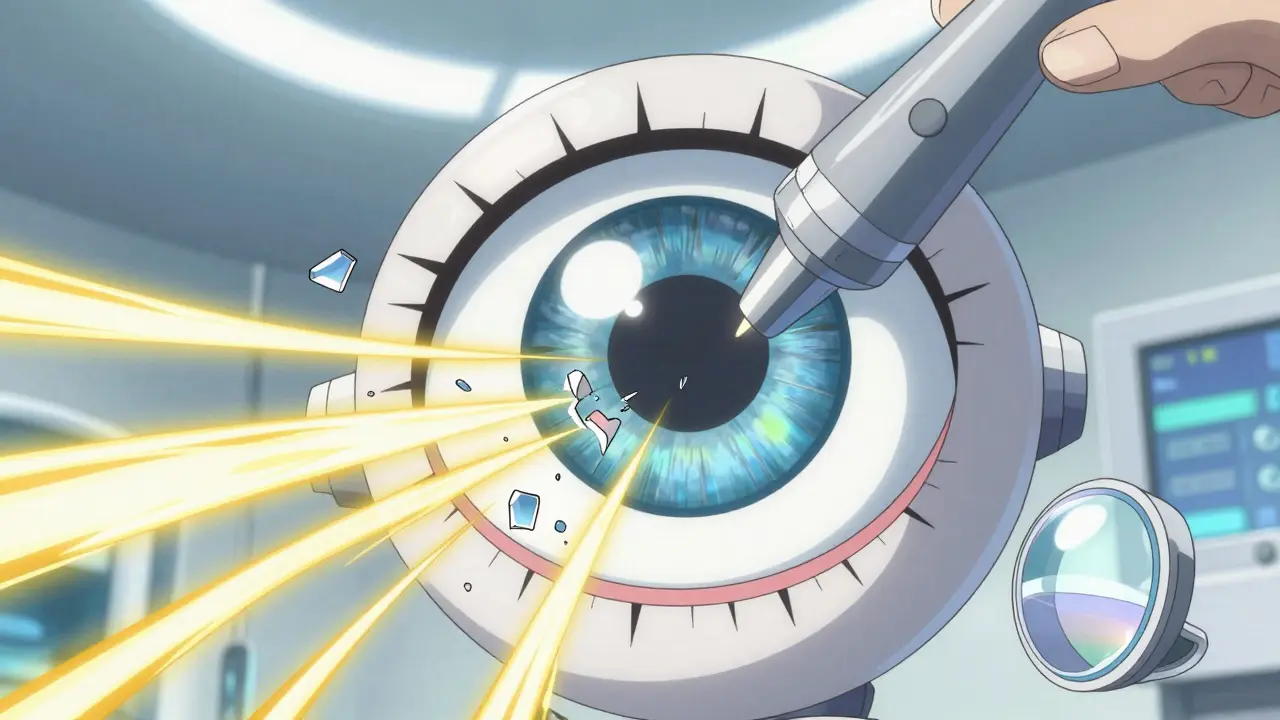
- An ultrasonic probe is inserted. This probe vibrates at a very high frequency to break the cloudy lens into tiny fragments.
- The fragments are gently vacuumed out of the eye.
- A foldable intraocular lens (or IOL) is inserted through the small incision and unfolded inside the lens capsule.
Choosing Your New Lens: Monofocal vs. Premium
One of the biggest decisions you'll make is which IOL to put in your eye. You aren't just getting a replacement; you're choosing how you want to see the world for the next several decades.| Lens Type | Primary Use | Pros | Cons | Estimated Cost (Out-of-pocket) |
|---|---|---|---|---|
| Monofocal | Single distance (usually far) | High clarity, standard insurance coverage | Will likely need reading glasses | $1,500 - $3,000 |
| Multifocal/Trifocal | Near, Mid, and Far vision | High spectacle independence | Potential for halos/glare | $2,500 - $4,500 |
| Toric | Corrects Astigmatism | Eliminates distorted vision | More expensive than standard | $2,500 - $4,500 |
The Road to Recovery: What to Expect
Recovery isn't an overnight switch. Your eye has undergone a significant change, and your brain needs time to calibrate. Right after surgery, it's common for things to look a bit blurry or for the eye to feel "scratchy" or "sticky." This is normal inflammation. Most people notice a significant jump in clarity within 1 to 3 days. However, a full recovery-where the eye is completely stable-usually takes anywhere from four to eight weeks. During this window, your surgeon will have you on a strict regimen of eye drops. Typically, this includes an antibiotic like moxifloxacin to prevent infection and a corticosteroid like prednisolone acetate to bring down swelling. To keep your recovery on track, follow these non-negotiable rules:- No heavy lifting: Avoid rigorous exercise or lifting heavy objects for several weeks to prevent pressure build-up in the eye.
- Keep it dry: Avoid getting water or soap directly in the surgical eye during the first few days.
- No driving: You cannot drive immediately after the procedure until your ophthalmologist gives you the green light.

When "Clear" Isn't Quite Enough: Post-Op Challenges
While the success rate is nearly 99.5%, surgery isn't always a magic wand. Some patients experience a condition called posterior capsule opacification. This happens when the membrane that holds the new lens becomes cloudy again. It's not a "second cataract," but it feels like one. The fix is simple: a quick procedure called a YAG laser capsulotomy that clears the clouding in seconds without needing another incision. Other patients find that their brain struggles to adapt to the new depth perception. This is where vision therapy comes in. By performing targeted exercises-such as shifting focus between a close object and a distant one-you can retrain your brain to process the new visual data more efficiently, reducing eye strain and mental fatigue.Is Surgery Right for You?
Choosing the right time for surgery is a balance between quality of life and risk. If you're still driving safely and reading comfortably, you might wait. But if you're struggling with night glare, find that your hobbies are becoming frustrating, or your doctor warns that the cataract is becoming "hyper-mature" (which makes surgery more complex), it's time to book a consultation. Remember that complications are rare, affecting only 2-5% of cases. However, if you have severe glaucoma or advanced diabetic retinopathy, the results might not be as dramatic because those conditions affect the retina and optic nerve, not just the lens. Always have a detailed conversation with your surgeon about your specific ocular health to set realistic expectations.Will I ever need this surgery again in the same eye?
No. Once the natural cloudy lens is removed and replaced with an artificial intraocular lens (IOL), you cannot develop another cataract in that eye because the biological lens that causes the clouding is gone.
Is cataract surgery painful?
The procedure itself is typically painless because the eye is numbed with local anesthesia. After surgery, you might feel some mild itching or a "gritty" sensation, but this is usually managed with prescribed eye drops and is not considered severe pain.
How long do I have to use the eye drops?
Antibiotic drops are usually used for about one week to prevent infection. Steroid drops to manage inflammation are often used longer and are gradually tapered off over a period of four weeks, depending on your surgeon's specific protocol.
Can I get rid of my glasses completely?
While multifocal or trifocal IOLs significantly increase the chance of being glasses-free, it's not guaranteed for everyone. Many patients with standard monofocal lenses will still need reading glasses for close-up work, though their distance vision will be greatly improved.
What happens if I don't get the surgery?
Cataracts are progressive. If left untreated, the clouding will continue to spread until it covers the entire lens, leading to a total loss of functional vision. More importantly, very advanced cataracts can make it harder for doctors to treat other eye issues, like glaucoma, because they can't see the back of the eye clearly.