Imagine walking into your local pharmacy to pick up a prescription you’ve taken for years, only to be told it’s out of stock. Not just delayed-gone. This isn’t a rare glitch anymore; it is the new normal for millions of patients. The root cause often traces back thousands of miles away, hidden in the complex web of international supply chains. We rely on foreign manufacturing for everything from active pharmaceutical ingredients (APIs) to sterile packaging materials, creating a fragile dependency that leaves our health systems vulnerable to global shocks.
In 2025, this vulnerability became starkly apparent. While global supply chain losses dropped to $184 billion compared to pandemic peaks, the structural risks remain high. Asia alone accounts for 50% of global manufacturing output, including a dominant share of the world's drug components. When geopolitical tensions rise or natural disasters strike, the ripple effects hit hospital shelves and home medicine cabinets with brutal speed. Understanding this dependence is no longer just an academic exercise-it is a matter of personal health security.
The Hidden Geography of Your Medicine
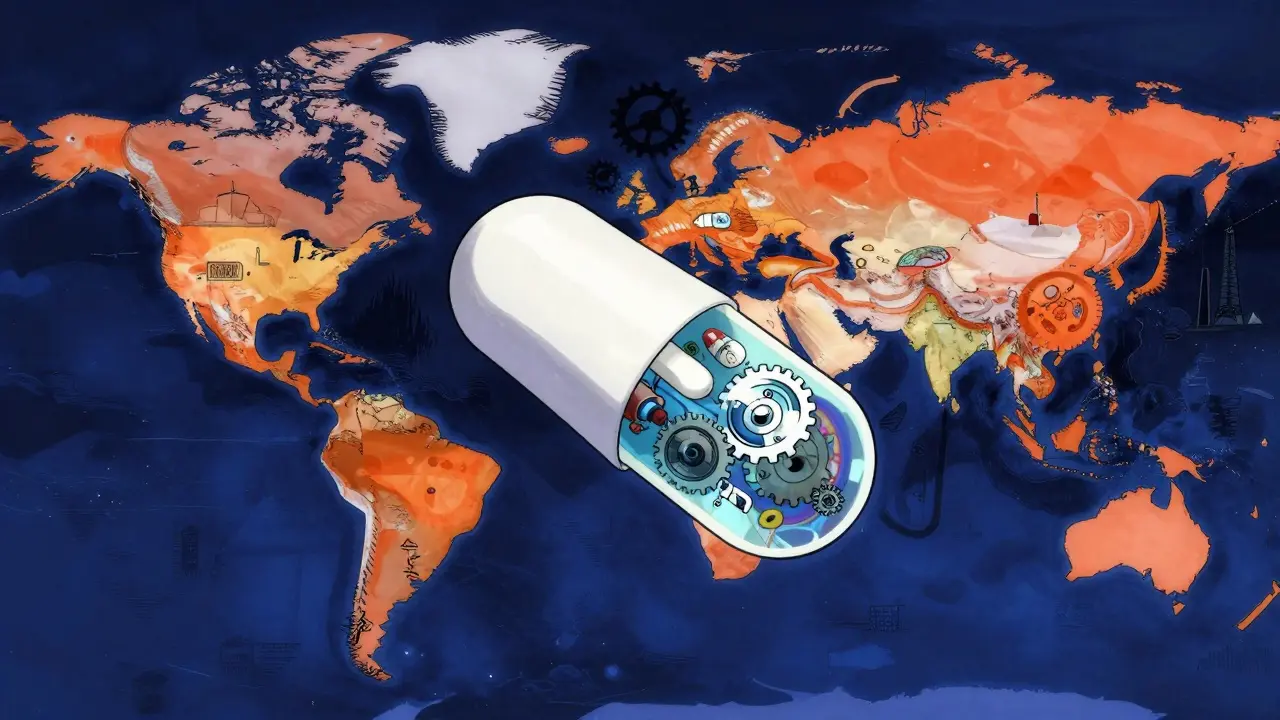
Most people assume their pills are made locally, but the reality is far more fragmented. A single tablet might contain an API synthesized in China, excipients from India, and blister packaging from Mexico, before being assembled in a facility in Europe or the United States. This fragmentation was designed for cost efficiency, not resilience. Under the General Agreement on Tariffs and Trade (GATT) frameworks established decades ago, companies optimized for the lowest possible production costs, leading to highly specialized regional hubs.
Today, China is the primary source for critical raw materials used in pharmaceutical manufacturing. Approximately 70-80% of the world’s APIs for antibiotics and painkillers originate there. Similarly, India is a major producer of generic drugs and vaccine components. This concentration creates a single point of failure. If a factory in Hebei province shuts down due to environmental inspections or power grid issues, hospitals in Bristol, Boston, or Berlin feel the impact within weeks. The average lead time for goods traveling from China to the United States has increased by 50% since 2019, meaning that even minor delays cascade into significant shortages.
The problem is compounded by the fact that many Western countries have offshored their own chemical synthesis capabilities. In the UK and US, fewer than five facilities produce certain essential antibiotic precursors. When demand spikes or supply lines break, there is no domestic buffer to catch the fall. You cannot simply "make more" overnight; building a compliant pharmaceutical plant takes years and billions in investment. This lack of redundancy is the core driver of modern drug shortages.
Why Resilience Costs More Than Efficiency
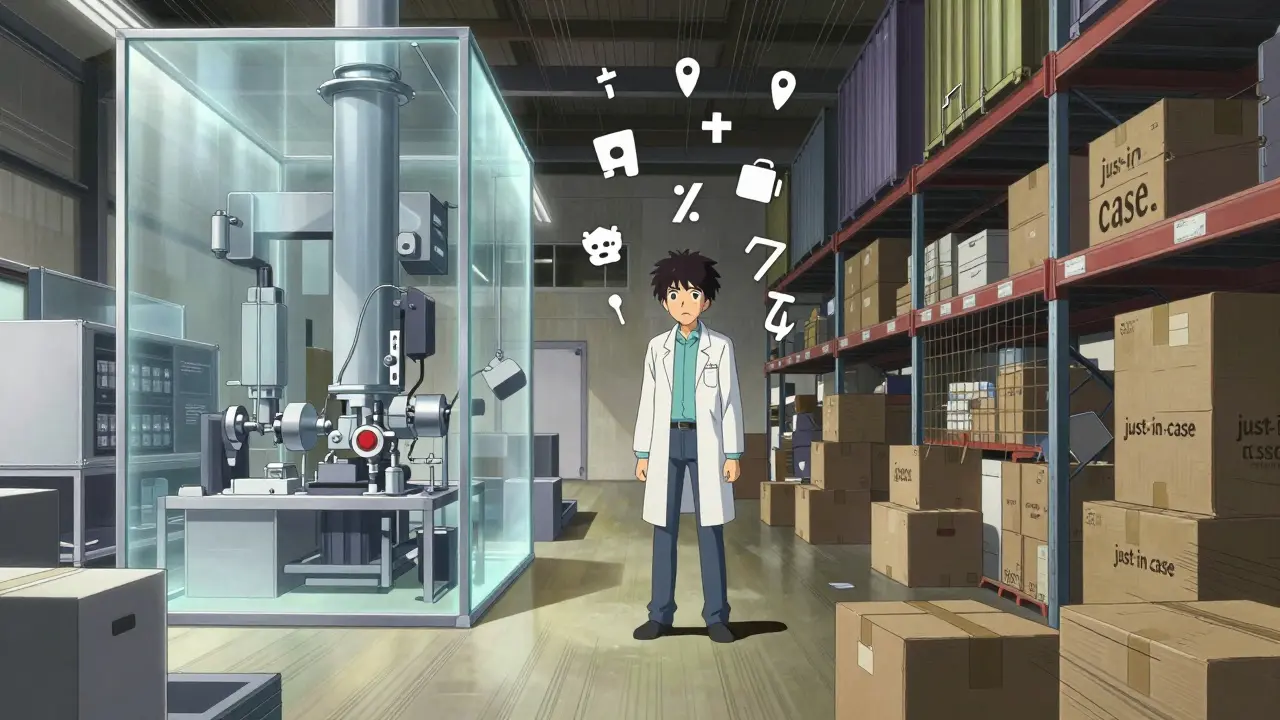
For decades, the mantra of global business was "just-in-time" delivery. Keep inventory low, order frequently, and save money. But in healthcare, this model is dangerous. A missed shipment of insulin or chemotherapy drugs isn’t an inconvenience; it is a life-threatening event. Despite this, many manufacturers still operate with razor-thin margins that leave no room for safety stock.
We are seeing a shift toward "just-in-case" strategies, but the transition is painful. McKinsey reports that companies adopting these models have increased stock levels by 15%, yet 78% of firms still struggle with supplier diversification. Why? Because maintaining multiple suppliers is expensive. It requires duplicating quality assurance processes, managing different regulatory standards, and paying higher freight costs. For example, nearshoring production to Mexico can reduce transportation costs by 30-40% compared to trans-Pacific shipping, but labor and setup costs may be 15-20% higher initially.
| Strategy | Cost Impact | Lead Time | Risk Level |
|---|---|---|---|
| Single-Source Asia | Lowest | Long (50% increase since 2019) | High |
| Nearshoring (e.g., Mexico) | Moderate (+15-20% labor) | Medium | Medium |
| Reshoring (Domestic) | Highest (Wages 4.8x higher) | Short | Low |
| Multi-Shoring (Diversified) | Moderate-High | Variable | Lowest |
The data shows a clear trade-off. Companies sticking with single-source Asian manufacturing face up to 120-day disruption periods during major port closures, while multi-shored competitors experience only 45 days. Yet, 56% of respondents in recent surveys report reducing product offerings because they cannot afford the upfront cost of diversification. This economic reality keeps many patients at risk, as companies prioritize short-term profitability over long-term supply security.
The Role of Geopolitics and Trade Barriers
Supply chains do not exist in a vacuum. They are deeply influenced by political decisions. In 2024-2025, the U.S. implemented 12 new tariff categories affecting $340 billion in imports, prompting 94% of companies to reassess their compliance strategies. These tariffs were intended to protect domestic industries, but they often had the opposite effect on drug availability. By raising the cost of imported components, tariffs squeezed manufacturer margins, forcing some to cut production volumes or delay launches.
Dr. Susan Lund of McKinsey & Company notes that the "geopolitical distance" of trade decreased by 7% between 2017 and 2024, indicating deliberate restructuring. However, this restructuring is uneven. While large multinational corporations can absorb the costs of moving factories, small and medium-sized enterprises (SMEs)-which represent 90% of businesses globally-are left behind. Dr. John Westerman of the World Economic Forum warns that these SMEs are particularly threatened by systemic shocks, as they lack the capital to invest in digital twins or AI-driven forecasting tools that larger rivals use to mitigate risk.
Furthermore, countermeasures weaken global competitiveness. When one nation imposes tariffs, others retaliate. In March 2025, trade forums highlighted how 60% of foreign countermeasures to U.S. tariffs were weakening the global competitiveness of affected goods, including medical devices. This tit-for-tat dynamic creates uncertainty, making it harder for any company to plan long-term investments in resilient infrastructure. The result is a stagnant market where innovation slows, and shortages persist.
Technology as a Double-Edged Sword
Digital transformation offers hope, but also introduces new vulnerabilities. By 2025, 68% of enterprises adopted AI in supply chain management, up from just 22% in 2020. Tools like digital twins allow companies to simulate disruptions and test responses without risking real-world stockouts. IoT-enabled logistics can reduce lead times by 20% in Asia by providing real-time visibility into container locations and conditions.
However, connectivity brings cyber risk. Sixty percent of manufacturers report concerns about cybersecurity in smart supply chains. A ransomware attack on a key API supplier could halt production across dozens of brands simultaneously. In 2025, the industry required an additional $18.7 billion in security investments to protect these digital assets. Without robust IT infrastructure, the very technologies meant to prevent shortages can become the vector for catastrophic failures.
Additionally, there is a severe talent gap. Thirty-three percent of companies report understaffing in global trade management positions. Managing a multi-shored, AI-driven supply chain requires skills that are currently scarce. Blockchain verification can reduce quality disputes by 65%, but it demands 30% higher IT investment and expertise that many traditional pharma firms simply do not possess. Until we address the workforce shortage, technology will remain an underutilized tool rather than a silver bullet.

What Patients Can Do Right Now
While governments and corporations debate reshoring policies, patients are left to navigate the fallout. Here are practical steps to manage the risk of drug shortages:
- Build a Personal Buffer: If your medication is stable and prescribed long-term, ask your doctor if you can get a 90-day supply instead of 30. This reduces the frequency of refills and gives you more time to find alternatives if a shortage occurs.
- Diversify Pharmacies: Don’t rely on a single pharmacy. Identify two or three nearby options, including independent shops and large chains. During shortages, stock varies wildly between providers.
- Know Generic Equivalents: Ask your pharmacist about therapeutic alternatives. Sometimes, a slightly different brand or formulation is available when the preferred one is not. Always consult your doctor before switching.
- Monitor Alerts: Subscribe to shortage alerts from national health agencies (like the FDA in the US or MHRA in the UK). Early warning allows you to act before shelves empty completely.
- Avoid Hoarding: Panic buying worsens shortages. Take only what you need. Collective restraint helps ensure equitable distribution for those who are critically ill.
These actions won’t fix the global supply chain, but they empower you to take control of your immediate health needs. Awareness is the first step toward resilience.
The Path Forward: Balanced Multi-Shoring
The future of pharmaceutical supply chains lies not in complete reshoring-which Professor Richard Baldwin argues is economically unfeasible due to wage disparities-but in balanced multi-shoring. IDC forecasts that 50% of companies will shift to this model by 2025, boosting supply reliability by approximately 10 percentage points. This approach combines nearshore partners for speed, offshore hubs for cost, and domestic facilities for critical, high-risk items.
Microfactories, promoted by the International Society of Automation, offer another solution. These smaller, automated units allow 25% faster response to local demand, though they require 40% higher initial automation investment. As generative AI improves decision-making workflows by 35%, these decentralized models will become more viable. The goal is a networked system where no single node holds all the power.
Regulatory support is crucial. Governments must incentivize domestic production of essential APIs through tax breaks and streamlined approvals. The renegotiation of agreements like the United States-Mexico-Canada Agreement (USMCA) could establish stable tariff rates, reducing uncertainty. Meanwhile, international cooperation on cybersecurity standards and workforce training will help close the skills gap.
Global GDP growth was cut to 2.9% in 2025, partly due to trade barriers. But if tensions de-escalate, the OECD forecasts recovery to 3.1% by 2027. Until then, we must accept that drug shortages are a symptom of a deeper structural issue. By understanding the dependence on foreign manufacturing, we can push for policies and practices that prioritize health over mere cost savings. Your medicine shouldn’t be a gamble based on geopolitics. It should be a guarantee.
Why are drug shortages happening so frequently?
Drug shortages are driven by heavy reliance on foreign manufacturing, particularly in Asia, which produces most active pharmaceutical ingredients. Geopolitical tensions, trade tariffs, and logistical bottlenecks disrupt these concentrated supply lines. Additionally, many manufacturers operate with low inventory buffers to save costs, leaving no room for error when delays occur.
Which countries produce the most medicines?
China and India are the dominant players. China supplies 70-80% of the world’s APIs for antibiotics and painkillers, while India is a major producer of generic drugs and vaccines. Other regions like Mexico and Eastern Europe handle assembly and packaging, but the critical raw materials largely come from Asia.
Can reshoring solve the shortage problem?
Reshoring helps for critical, high-risk items, but it is not a complete solution. Manufacturing wages in the U.S. and Europe are significantly higher than in Asia, making full reshoring economically difficult for many companies. A balanced approach called multi-shoring, which diversifies sources across several regions, is considered more sustainable and resilient.
How do tariffs affect my medication?
Tariffs raise the cost of imported components, squeezing manufacturer profits. To maintain margins, companies may reduce production volumes, delay new drug launches, or pass costs to consumers. Retaliatory tariffs from other countries can further destabilize supply chains, leading to unpredictable shortages and price hikes.
What is multi-shoring in supply chains?
Multi-shoring is a strategy where companies source materials and manufacture products in multiple geographic regions rather than relying on a single country. This reduces risk by ensuring that if one region faces a disruption (like a natural disaster or trade ban), others can continue supplying. It increases reliability but often comes with higher initial setup costs.