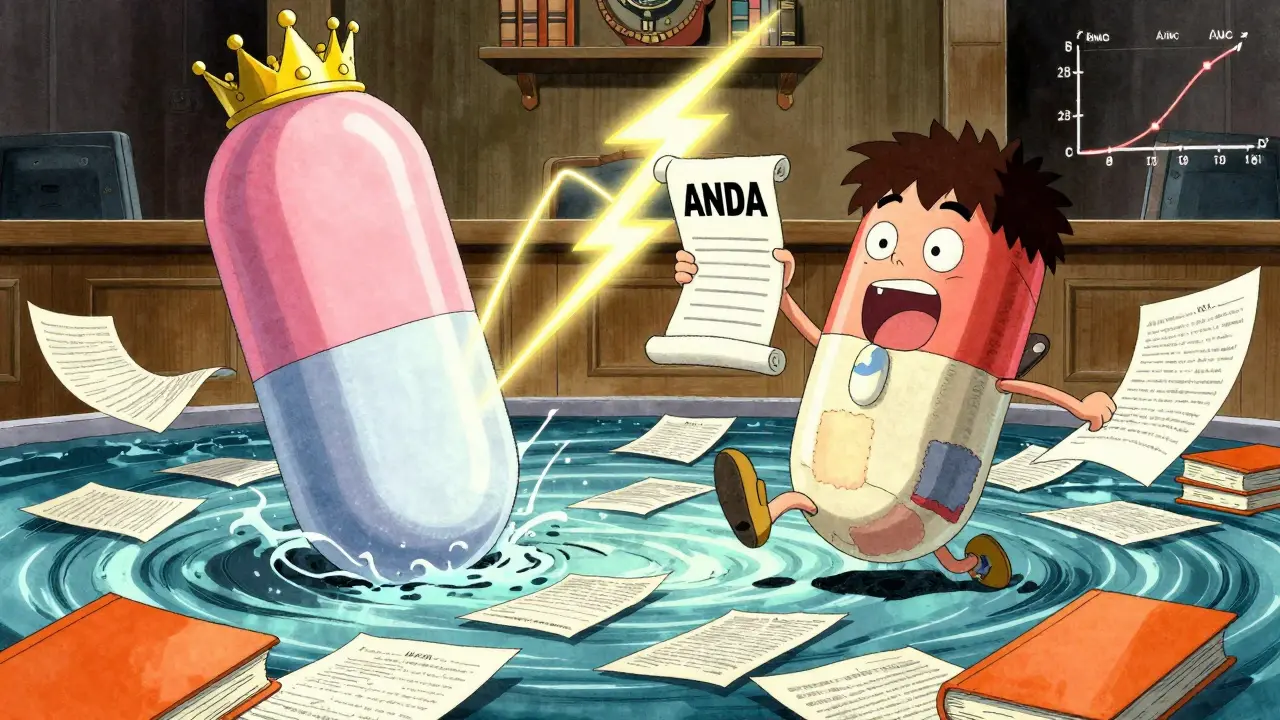
The Hatch-Waxman Act didn’t just change how generic drugs get approved-it rewrote the rules of the entire U.S. pharmaceutical market. Before 1984, if you wanted to make a copy of a brand-name drug, you had to start from scratch: run your own clinical trials, prove safety and effectiveness all over again, even though the original drug had already been approved by the FDA. It cost about $2.6 million in today’s dollars and took years. Few companies could afford it. As a result, generics made up just 19% of prescriptions. Today, they make up over 90%-and save Americans more than $158 billion every year.
What the Hatch-Waxman Act Actually Did
The Drug Price Competition and Patent Term Restoration Act of 1984, nicknamed after its sponsors Senator Orrin Hatch and Representative Henry Waxman, solved two problems at once. First, it gave brand-name drug companies a way to recover time lost during FDA review by extending their patents. Second, it created a fast, affordable path for generic manufacturers to enter the market. That path? The Abbreviated New Drug Application, or ANDA.Before ANDA, generic companies had to submit full new drug applications (NDAs)-the same ones brand-name makers used. That meant repeating expensive animal and human trials. The Hatch-Waxman Act said: "If your generic is identical in active ingredient, strength, dosage form, and route of administration to the brand drug, you don’t need to prove safety or effectiveness again. Just prove you absorb into the body the same way."
That’s called bioequivalence. The FDA requires that the generic drug’s absorption rate and amount-measured by Cmax and AUC-fall within 80% to 125% of the brand drug’s. It’s not about looking the same. It’s about performing the same. And the data? It’s gathered through small, controlled studies in healthy volunteers, not full-scale clinical trials.
The Orange Book: The Map to Generic Approval
If you’re a generic manufacturer, the FDA’s Approved Drug Products with Therapeutic Equivalence Evaluations-better known as the Orange Book-is your roadmap. It lists every approved brand-name drug and all the patents tied to it. Each patent gets a code: method of use, formulation, delivery system. Generic companies use this list to figure out when they can legally launch.Here’s where it gets strategic. When a generic company files an ANDA, it must make one of four patent certifications:
- Paragraph I: No patents listed.
- Paragraph II: Patents have expired.
- Paragraph III: We’ll wait until the patent expires.
- Paragraph IV: This patent is invalid or we won’t infringe it.
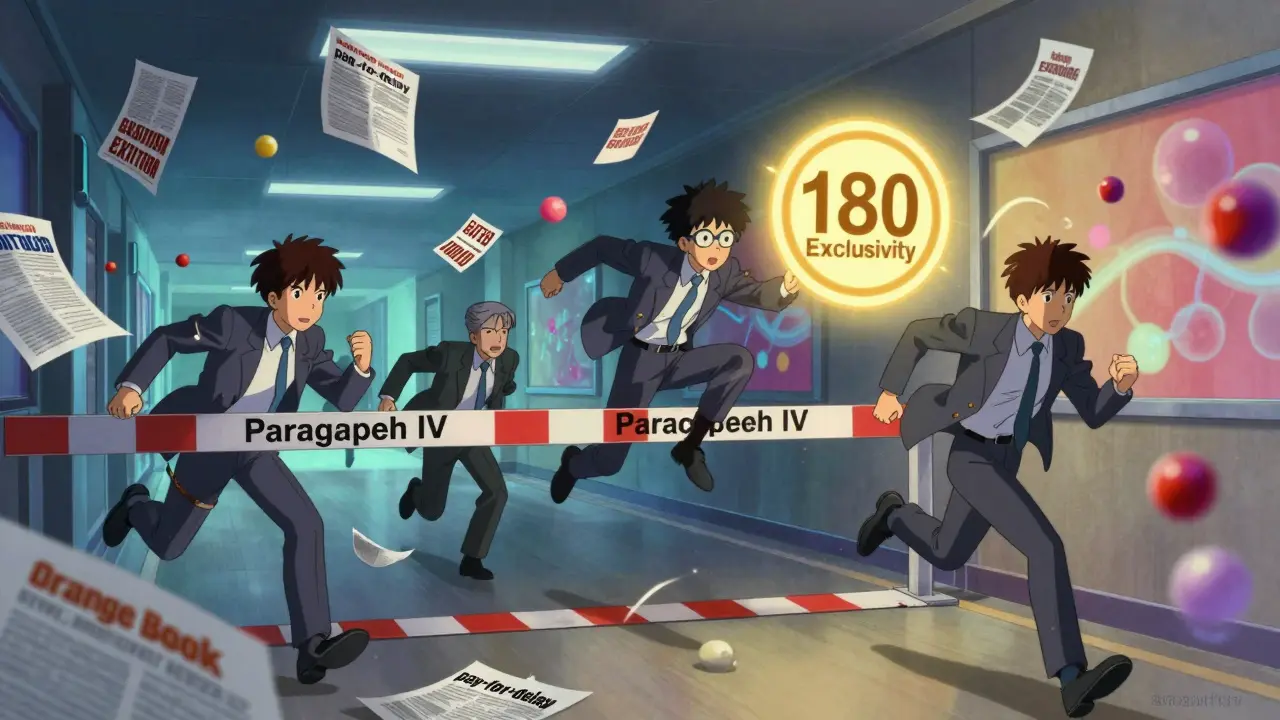
Paragraph IV is the big one. It’s a legal challenge. File it, and you trigger a clock. The brand-name company has 45 days to sue you for patent infringement. If they do, the FDA can’t approve your drug for 30 months-unless the court rules in your favor sooner. But here’s the catch: the first company to file a Paragraph IV certification gets 180 days of exclusive market rights. No other generic can enter during that time.
Why the 180-Day Exclusivity Matters
Imagine you’re the first to challenge a patent on a blockbuster drug. You spend millions on legal fees, clinical testing, and regulatory paperwork. If you win, you get a 180-day window where you’re the only generic on the market. That’s when you can charge a premium-sometimes 50% less than the brand, but still far more than what you’ll charge once others enter.That incentive has driven hundreds of patent challenges. About 90% of Paragraph IV filings lead to lawsuits. And because the clock starts when you file-not when you get approved-companies race to submit applications the moment a patent expires or is challenged. In the early 2000s, generic manufacturers would camp outside FDA offices, waiting for the first moment they could hand in their paperwork.
Today, the FDA has rules to prevent abuse. If two companies file on the same day, they share the 180-day exclusivity. If the first filer delays approval without good reason, they lose it. And if they don’t launch within 75 days of approval, the exclusivity is forfeited. Still, there are cases where brand and generic companies strike secret deals-"pay-for-delay"-where the brand pays the generic to stay off the market. These are illegal under antitrust law, but they’ve happened often enough to spark congressional investigations.
How Generic Drugs Are Made and Approved
Making a generic isn’t just copying a pill. It’s matching the exact chemical structure, the same inactive ingredients (fillers, dyes, binders), and the same manufacturing process. The FDA inspects the facilities-often overseas-just like they do for brand-name makers. In 2023, the FDA approved 746 ANDAs. That’s more than two per day.But it’s not easy. A typical drug has about 1.5 patents listed when it’s first approved. By the time it’s ready for generics, that number jumps to 3.5 or more. Companies stack patents on minor changes-new coatings, new dosing schedules, new delivery methods. This is called "evergreening." It’s legal, but it delays competition.
Generic manufacturers have become experts at navigating this. Companies like Teva, Viatris, and Sandoz have entire legal and regulatory teams focused on Hatch-Waxman strategy. They track patent expirations, analyze litigation risks, and time their ANDA filings to the month. The average cost to develop a generic? $5 to $10 million. The average time from filing to approval? 3 to 4 years.
The Real Impact: Savings, Access, and Shortages
The numbers speak for themselves. Since 1984, generic drugs have saved the U.S. healthcare system an estimated $1.7 trillion. In 2023, 78% of Medicare Part D prescriptions were filled with generics. The average beneficiary saved $3,200 that year.But there’s a flip side. When a drug has only one or two generic makers, prices can spike. If one manufacturer shuts down production-or if there’s a quality issue-shortages follow. In 2023, 283 generic drugs were in short supply. Many are old, cheap drugs made by low-margin producers. When the cost to make them is barely above the price they can sell for, companies walk away.
And then there are the complex drugs. Hatch-Waxman was built for small-molecule pills. It doesn’t work well for biologics-large, complex proteins made from living cells. That’s why Congress passed the Biologics Price Competition and Innovation Act (BPCIA) in 2010, creating a separate pathway for biosimilars. But even that system is slower, more expensive, and less competitive than Hatch-Waxman.
What’s Next for Generic Drug Approval?
The FDA is trying to keep up. Under GDUFA III (Generic Drug User Fee Amendments), review times dropped from 36 months in 2012 to 18 months in 2023. The agency is also cracking down on brand companies that refuse to provide samples of their drugs to generic makers-something required by the 2019 CREATES Act. Without those samples, generic companies can’t test bioequivalence.Congress is debating reforms. Should the 180-day exclusivity be limited? Should "patent thickets" be easier to challenge? Should pay-for-delay deals be banned outright? The Congressional Research Service says the Act still works-but it’s strained. As more complex drugs come off patent, the system will need updates.
For now, Hatch-Waxman remains the backbone of generic drug approval in the U.S. It’s not perfect. But without it, most Americans wouldn’t have access to affordable medications. It’s the reason you can buy a 30-day supply of lisinopril for $4 at Walmart. And it’s why the generic drug market-now worth $70 billion-keeps growing.
What is the ANDA process under the Hatch-Waxman Act?
The Abbreviated New Drug Application (ANDA) is the streamlined pathway created by the Hatch-Waxman Act for generic drug approval. Instead of repeating full clinical trials, generic manufacturers must prove their product is pharmaceutically equivalent to the brand-name drug and bioequivalent-meaning it delivers the same amount of active ingredient into the bloodstream at the same rate. This is shown through pharmacokinetic studies, not human outcome trials.
What is the Orange Book and why is it important?
The Orange Book, officially called "Approved Drug Products with Therapeutic Equivalence Evaluations," is a public list published by the FDA that includes all approved brand and generic drugs, along with their patent and exclusivity information. Generic manufacturers use it to identify which patents they need to challenge before launching. It’s the official source for determining when a generic can legally enter the market.
What does a Paragraph IV certification mean?
A Paragraph IV certification is a legal statement made by a generic drug applicant claiming that a patent listed in the Orange Book is either invalid or won’t be infringed by the generic product. This triggers a patent lawsuit from the brand-name company. If the generic wins, it gets 180 days of market exclusivity-the biggest financial incentive in the entire system.
Why do some generic drugs cost more than others?
Price depends on competition. If only one or two companies make a generic, prices stay higher. Once five or more enter the market, prices often drop 80-90%. But if manufacturing is complex, demand is low, or supply is disrupted (like during a factory shutdown), shortages can occur and prices spike. Some older generics cost more simply because no one wants to make them profitably.
Can the Hatch-Waxman Act be used for biologics?
No. The Hatch-Waxman Act was designed for small-molecule drugs-pills and injections with simple chemical structures. Biologics, like insulin or Humira, are large, complex proteins made from living cells. Their copies, called biosimilars, require a different approval pathway created by the Biologics Price Competition and Innovation Act (BPCIA) of 2010. Biosimilar approval is slower, more expensive, and less competitive than generic approval under Hatch-Waxman.
What are "pay-for-delay" deals and are they legal?
Pay-for-delay occurs when a brand-name drug company pays a generic manufacturer to delay launching its cheaper version. These settlements are meant to avoid costly litigation, but they prevent competition and keep prices high. The FTC and courts have ruled these deals illegal under antitrust law if they’re designed solely to delay generic entry. However, proving intent is difficult, and some deals still happen.