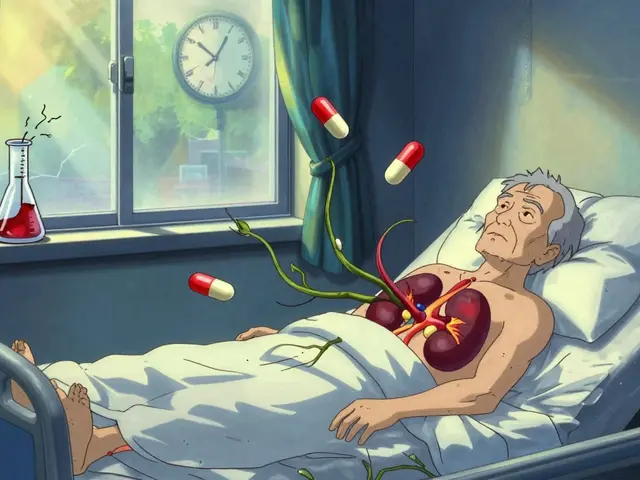

Imagine taking two pills at the same time - one for your blood pressure, another for your depression - and not realizing they’re fighting over the same metabolic highway inside your liver. That’s exactly what happens with CYP450 enzymes. These proteins don’t just break down drugs; they decide whether your medication works, fails, or turns toxic. And if you’re on more than a few prescriptions, you’re probably caught in this silent battle every single day.
What Are CYP450 Enzymes, Really?
CYP450 enzymes are a family of liver proteins that handle about 90% of all prescription drugs. Think of them as bouncers at a nightclub - only one drug can get processed at a time. The most important ones? CYP3A4, which manages half of all medications, and CYP2D6, which handles a quarter, including many antidepressants and heart drugs. Others like CYP2C9, CYP2C19, and CYP1A2 chip in with the rest. Together, they’re responsible for turning drugs into forms your body can flush out - usually by making them less active. But sometimes, they do the opposite: they activate prodrugs like clopidogrel or codeine, turning them into their real, powerful forms.
These enzymes aren’t just in your liver. They’re also in your gut, kidneys, lungs, and even the placenta. That’s why grapefruit juice - which blocks intestinal CYP3A4 - can make your cholesterol drug, like simvastatin, skyrocket in your bloodstream. One glass can reduce clearance by up to 80%. That’s not a myth. That’s a hospital admission waiting to happen.
How Drugs Compete: Inhibition vs. Induction
There are two main ways drugs mess with CYP450 enzymes: inhibition and induction. Inhibition is like cutting the power to a machine. When a drug like clarithromycin or fluoxetine blocks CYP3A4 or CYP2D6, it slows down how fast other drugs get broken down. That means those drugs build up. A 72-year-old woman on simvastatin who added clarithromycin saw her simvastatin levels jump tenfold - and ended up with rhabdomyolysis, a dangerous muscle breakdown. That’s not rare. It’s textbook.
Induction is the opposite. It’s like turning up the volume on the machine. Drugs like rifampin or St. John’s wort force your body to make more CYP450 enzymes. That means drugs get cleared too fast. Take birth control pills - if you start taking rifampin, your body clears the hormones so quickly you can get pregnant. Or if you’re on warfarin and start taking carbamazepine, your INR drops. Suddenly, your blood doesn’t clot like it should. That’s induction in action.
Reversible inhibition is the most common. It happens when two drugs compete for the same enzyme spot. The one with higher binding affinity wins. If Drug A binds 10 times tighter than Drug B, Drug B’s metabolism can drop by 90%. That’s why fluvoxamine, a strong CYP1A2 inhibitor, can cause theophylline levels to spike from 10 to 25 mcg/mL - enough to trigger seizures. One Reddit user described this exact scenario. No guesswork. Real patient. Real danger.
Genetics Play a Bigger Role Than You Think
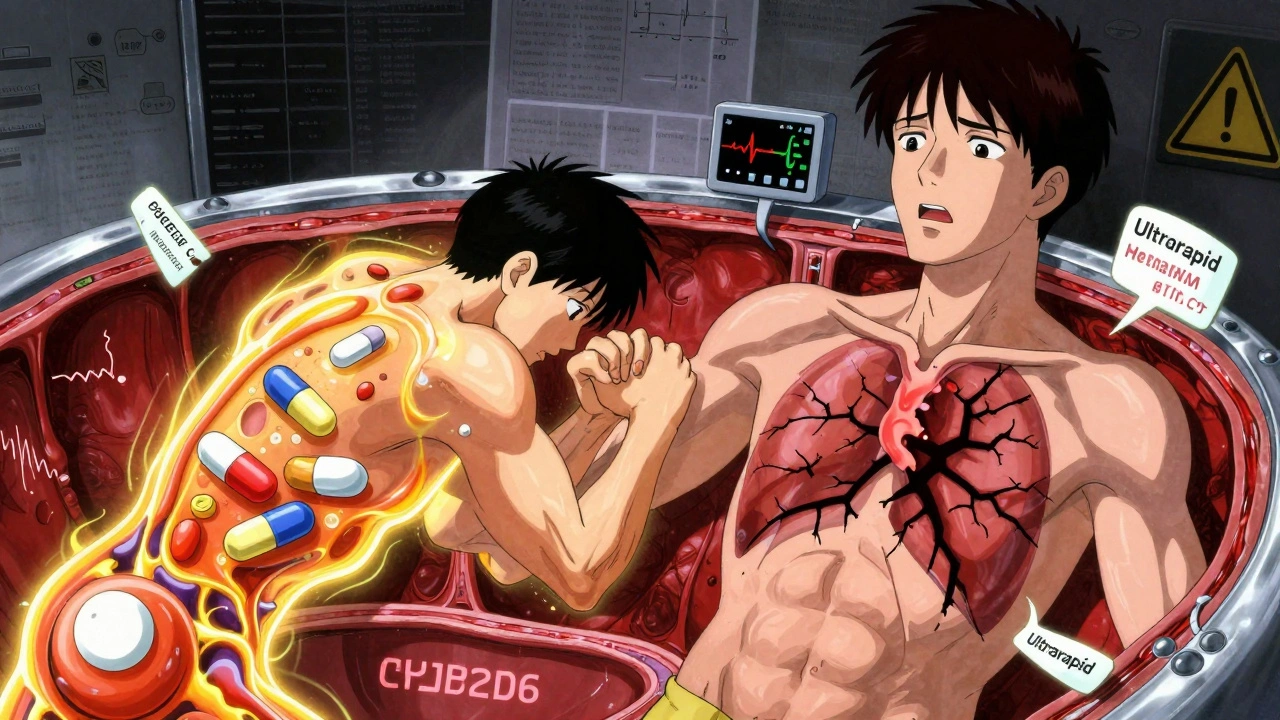
Not everyone metabolizes drugs the same way. Your genes decide whether you’re a poor, intermediate, extensive, or ultrarapid metabolizer. For CYP2D6, 5-10% of white people are poor metabolizers. That means they can’t activate codeine into morphine. They get no pain relief. Meanwhile, ultrarapid metabolizers - common in North Africa and the Middle East - turn codeine into morphine too fast. They can overdose on a standard dose. One study showed a patient on codeine had no pain control because her body cleared morphine before it could work. That’s not a failed drug. That’s a failed genetic match.
CYP2C19 is another big one. About 30% of Caucasians and 60% of Asians are poor metabolizers of clopidogrel. That’s a blood thinner. If you’re a poor metabolizer, the drug doesn’t work. You’re at risk for a heart attack or stroke - even though you’re taking it exactly as prescribed. The FDA recommends testing for this before prescribing clopidogrel. Yet, most doctors still don’t. Why? Because they don’t know. Or they think it’s too expensive. But testing costs $250-$500 and takes less than a week. It’s cheaper than a heart attack.
Real-World Consequences: From Bradycardia to Seizures
These interactions aren’t theoretical. They’re happening in clinics, ERs, and nursing homes every day. Nurses report that combining SSRIs like paroxetine with beta-blockers like metoprolol causes bradycardia in 15-20% of patients. Why? Both are handled by CYP2D6. The SSRI blocks the enzyme. The beta-blocker builds up. Heart rate drops. Dizziness. Fainting. That’s not a coincidence. That’s a predictable drug interaction.
Another case: a man on theophylline for asthma started taking fluvoxamine for depression. Within 48 hours, his theophylline level tripled. He had a seizure. Theophylline has a narrow therapeutic window. Even small increases can be deadly. Fluvoxamine is a strong CYP1A2 inhibitor. The combination was a recipe for disaster. This isn’t a fluke. It’s a pattern.
And it’s not just prescription drugs. Herbal supplements like St. John’s wort induce CYP3A4. If you’re on cyclosporine after a transplant, this herb can drop your drug levels by 50%. Organ rejection follows. People don’t think of herbs as drugs. But they’re metabolized the same way. And they’re just as dangerous.
What Can You Do About It?
You don’t need to be a pharmacist to protect yourself. Start by asking your doctor or pharmacist: “Could any of my medications be competing for the same enzyme?” That’s it. That simple question can prevent hospitalization.
Use tools. Pharmacies use Lexicomp or Micromedex - systems that flag interactions with 95% accuracy. Hospitals with clinical decision support systems reduce CYP-related adverse events by 35%. You can’t access those systems, but you can ask your pharmacist to run a check. Many offer free interaction screenings.
Keep a list. Write down every pill, patch, vitamin, and herbal supplement you take. Bring it to every appointment. Don’t assume your doctor knows. Most don’t. Only 28% of primary care physicians routinely check for CYP interactions, according to JAMA. Pharmacists? 42%. You’re your own best advocate.
Genetic testing is becoming more accessible. If you’re on multiple meds - especially psych drugs, blood thinners, or painkillers - ask about CYP2D6 or CYP2C19 testing. Some insurance covers it. If not, the out-of-pocket cost is less than a month’s co-pay. It’s worth it.

The Bigger Picture: Why This Matters Now
The average Medicare patient takes 5.4 medications. That’s over 10 potential CYP450 interactions per person. And it’s getting worse. More drugs. More seniors. More herbs. More supplements. By 2030, 80% of new drugs will still rely on CYP450 metabolism. That means these interactions aren’t going away. They’re multiplying.
Technology is catching up. IBM Watson’s drug interaction AI hit 89% accuracy in beta testing. Epic, Cerner, and Allscripts now push real-time alerts in electronic records. But adoption is uneven. Only 42% of U.S. hospitals have full systems in place. The rest? Still relying on memory and paper lists.
That’s why you can’t wait for the system to fix itself. You need to act. Know your meds. Know your genes. Know your enzymes. Because when two drugs fight over CYP450, the winner isn’t always the one you want.
Can grapefruit juice really affect my medications?
Yes. Grapefruit juice blocks CYP3A4 in your gut, which can cause drugs like simvastatin, felodipine, or cyclosporine to build up to dangerous levels. Even one glass can reduce drug clearance by 30-80%. It’s not just grapefruit - Seville oranges and pomelos do the same. If your pill has a warning about grapefruit, avoid it completely.
Are over-the-counter drugs safe with my prescriptions?
Not always. Common OTCs like dextromethorphan (cough syrup), ranitidine (Zantac), and even some antihistamines are metabolized by CYP2D6 or CYP3A4. Mixing them with antidepressants or heart meds can cause serious side effects. Always check with a pharmacist before taking anything new, even if it’s sold without a prescription.
Why do some people need lower doses of the same drug?
Genetics. About 5-10% of people are poor metabolizers of CYP2D6 - meaning they break down drugs like codeine, metoprolol, or fluoxetine very slowly. They can get side effects at normal doses. Others are ultrarapid metabolizers and clear drugs too fast, making them ineffective. Dosing isn’t one-size-fits-all. It’s gene-dependent.
Is CYP450 testing covered by insurance?
Sometimes. Medicare and some private insurers cover testing if you’re on high-risk drugs like clopidogrel, tamoxifen, or certain antidepressants. Costs range from $250 to $500. If insurance doesn’t cover it, ask your doctor if the test is medically necessary - that can help with appeals. The results can change your entire treatment plan.
What should I do if I’m on five or more medications?
Schedule a medication review with your pharmacist. Ask them to check for CYP450 interactions, especially between antidepressants, heart meds, painkillers, and anticoagulants. Keep a written list. Use an interaction checker app like Medscape or Epocrates. Don’t assume everything’s fine just because your doctor prescribed it. Polypharmacy is the #1 risk factor for CYP-related harm.
Final Thought: Knowledge Is Your Shield
CYP450 interactions aren’t mysterious. They’re predictable. They’re measurable. They’re preventable. The problem isn’t the science. It’s the silence. Most patients don’t know their enzymes exist. Most doctors don’t test for them. But you can change that. Ask questions. Demand checks. Know your meds. Your body doesn’t just process drugs - it fights over them. And you deserve to win that fight.