When a generic drug company submits an application to the FDA, the clock starts ticking - but not all applications are treated the same. Two paths exist: priority review and standard review. The difference isn’t just paperwork. It’s money, timing, and access to patients who need affordable medicine. Understanding how the FDA decides which generic drugs get fast-tracked can help explain why some drugs hit shelves months ahead of others - and why others stall.
What’s the Difference Between Priority and Standard Review?
The FDA doesn’t review every generic drug application the same way. Since October 2022, under the Generic Drug User Fee Amendments (GDUFA) III, the agency has set clear timelines:
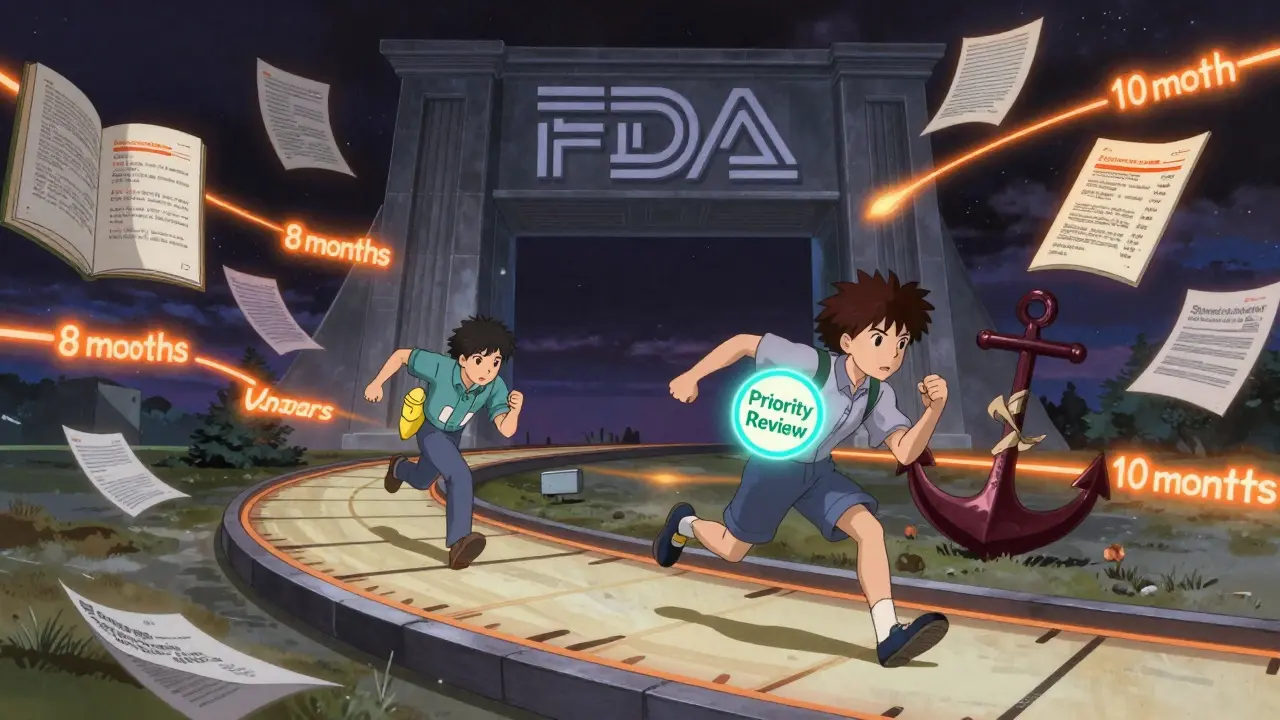
- Standard review: 10 months from the date the application is accepted for filing.
- Priority review: 8 months - two months faster.
That 60-day gap might not sound like much, but in the generic drug world, it’s everything. The first company to get approval for a generic version of a brand-name drug gets 180 days of exclusive market rights. During that time, no other generic can enter. That exclusivity window can mean hundreds of millions in extra revenue. For a company, getting priority review isn’t just a perk - it’s a competitive advantage.
Most applications - about 70% - fall under standard review. These are generics for drugs that already have one or more generics on the market. No exclusivity. No rush. Just a routine check to make sure the generic matches the brand in strength, safety, and how the body absorbs it.
Who Gets Priority Review?
Not every company can jump the queue. The FDA only gives priority review to applications that meet very specific criteria:
- First generics: The very first application submitted for a drug after its patent expires. If you’re the first to file a complete application and meet all requirements, you’re eligible.
- Drugs in shortage: If the brand-name drug - or any existing generic - is in short supply, the FDA will fast-track any new applicant. This is critical for drugs like insulin, antibiotics, or chemotherapy agents where patients can’t wait.
- Medically important advances: If a generic offers a real improvement over existing versions - say, a more stable formulation or easier dosing - it might qualify.
The FDA tracks patent and exclusivity status through its Orange Book, a public database that shows which drugs are still under protection. In 2022, 92.7% of first-generic applications received the 180-day exclusivity period. That’s how valuable being first really is.
In 2022, 83.1% of priority review applications met the 8-month goal. For standard, it was 72.3%. The gap shows the system works - but only if the application is clean.
The New U.S. Manufacturing Pilot Program
In October 2023, the FDA added a new twist: the ANDA Prioritization Pilot Program. This isn’t just about speed - it’s about where the drug is made.
To qualify for this bonus review boost, a generic drug must meet all three of these criteria:
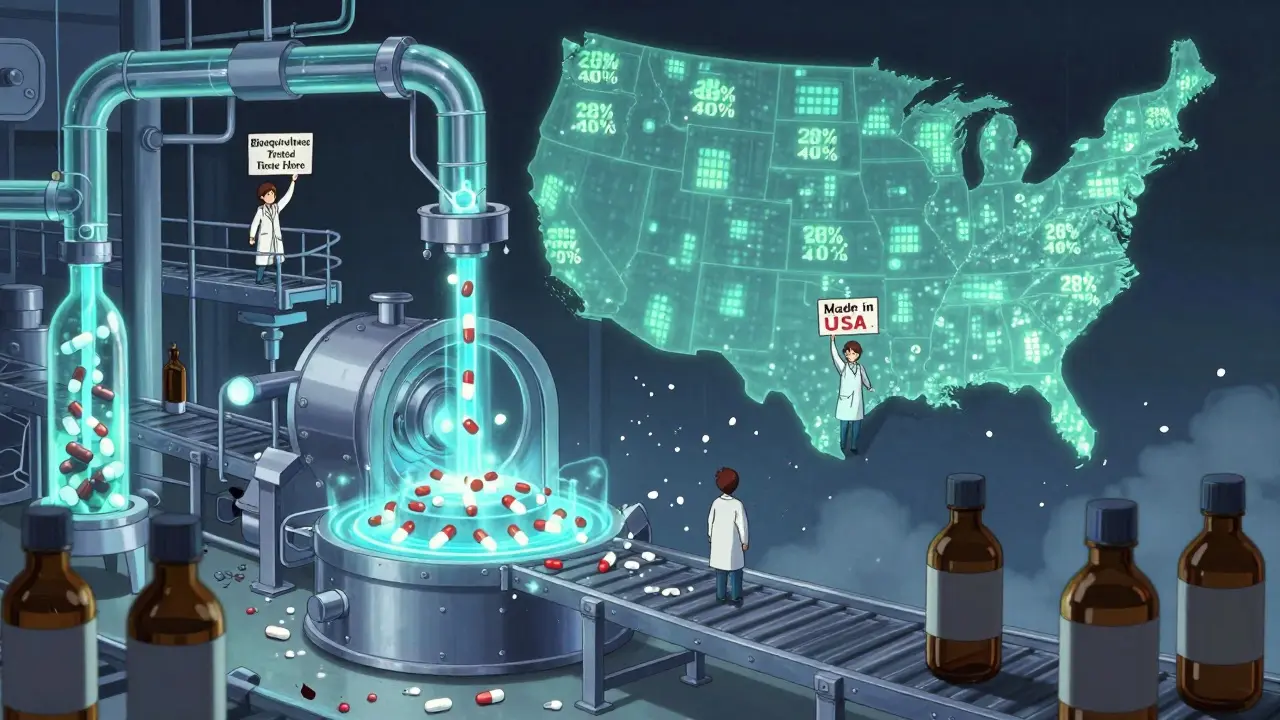
- The bioequivalence studies (the tests proving the generic works like the brand) were done in the U.S.
- The final pill or injection was manufactured in a U.S. facility.
- The active ingredient (API) came from a U.S.-based supplier.
This isn’t a small ask. Right now, only 12.3% of generic drug makers meet all three conditions. Why? Because for decades, the industry relied on overseas suppliers. About 80% of active pharmaceutical ingredients were made outside the U.S. before the pandemic. When supply chains broke down, shortages spiked. The FDA’s new rule is a direct response.
Companies are responding. Major players like Teva, Sandoz, and Hikma have increased U.S.-based bioequivalence testing by 22% since late 2022. Contract labs like PPD and Covance are seeing a 35% surge in U.S. clinical studies. But it’s not easy. One industry insider on Reddit noted that 92% of the special ingredients used in complex generics still come from Europe and Asia. Shifting all production to the U.S. isn’t feasible overnight.
The FDA estimates this pilot will speed up review for 45 to 60 applications each year. Commissioner Califf said the goal is to raise the share of U.S.-made generic drugs from 28% to 40% within five years.
Why So Many Applications Get Delayed
Even if you qualify for priority review, you can still get stuck. The biggest reason? Incomplete or poorly written applications.
Every application goes through a 74-day filing review. If it’s missing data, has unclear chemistry details, or doesn’t prove bioequivalence properly, the FDA sends a Refuse-to-Receive letter. The company must resubmit - and pay the full $164,880 filing fee again.
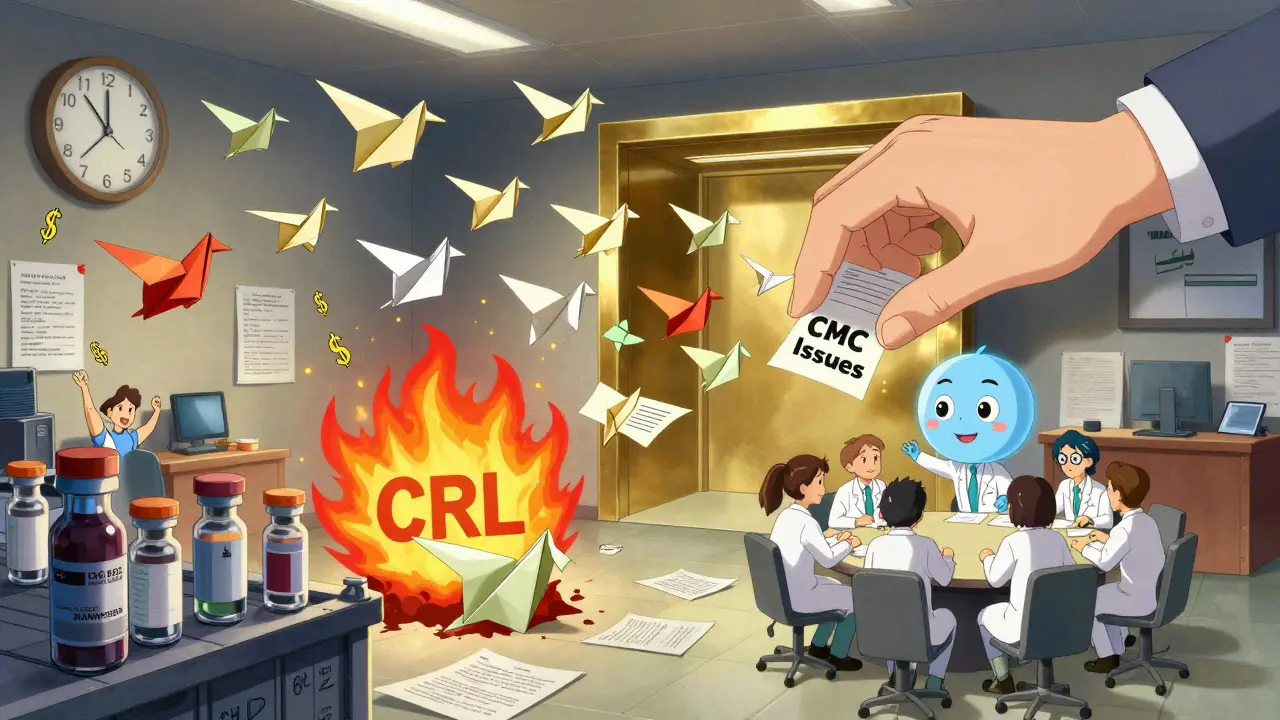
Even after filing, many applications get hit with a Complete Response Letter (CRL). In 2022, over 31% of original ANDAs received at least one CRL. The top reason? Chemistry, manufacturing, and controls (CMC) issues - 47.2% of delays came from problems in how the drug was made.
On average, an application needs 1.7 review cycles to get approved. Each cycle adds about 4.2 months to the timeline. So even a priority review can stretch beyond 8 months if the company keeps missing the mark.
How Companies Are Adapting
Smart companies aren’t waiting for approval - they’re preparing for it.
In 2020, only 41% of generic manufacturers held pre-submission meetings with the FDA. By 2023, that number jumped to 63%. These meetings let companies ask questions before submitting. They get feedback on their testing plans, manufacturing setup, or labeling. The result? First-cycle approval rates rose from 24.1% to 38.7% for those who participated.
For complex drugs - like inhalers, topical creams, or extended-release pills - the FDA launched a separate pilot in January 2023. These products account for nearly 20% of pending applications but only 10% of approvals. Why? They’re harder to replicate. A simple pill is one thing. A metered-dose inhaler that delivers the exact same dose as the brand? That’s science on a whole different level.
The Big Picture: Why This Matters
Generic drugs make up 88.6% of all prescriptions in the U.S. - but only 15.3% of total drug spending. That’s the power of competition. When multiple generics enter the market, prices drop fast. A drug that costs $500 a month as a brand might fall to $15 within a year of generics launching.
The FDA’s review system is designed to balance speed and safety. Too slow, and patients wait. Too fast, and quality suffers. The priority review system, combined with the new U.S. manufacturing push, is trying to do both: get life-saving generics to patients faster - and keep supply chains secure.
By 2026, analysts expect these changes to cut average approval times by 4.3 months. That could save the U.S. healthcare system over $18 billion a year.
It’s not perfect. Delays still happen. Supply chains are fragile. But the system is evolving - and it’s working.
What’s the main difference between priority and standard review at the FDA?
The main difference is the review timeline. Standard review takes up to 10 months from the date of filing, while priority review is completed in 8 months. Priority review is reserved for first generics, drugs in shortage, or products with a meaningful clinical advantage. The faster timeline can mean hundreds of millions in extra revenue for the first company to market.
Can any generic drug company get priority review?
No. Only applications that meet specific criteria qualify: being the first to file for a drug after patent expiry, addressing a drug shortage, or offering a significant improvement over existing versions. The FDA uses its Orange Book to verify patent status and exclusivity. Most applications - about 70% - are standard review.
What is the ANDA Prioritization Pilot Program?
Launched in October 2023, this program gives an extra review boost to generic drug applications that use U.S.-based manufacturing. To qualify, the drug’s active ingredient must come from a U.S. supplier, the final product must be made in a U.S. facility, and bioequivalence studies must be conducted in the U.S. It’s part of a broader effort to reduce reliance on overseas supply chains.
Why do so many generic drug applications get delayed?
The most common reason is incomplete or flawed submissions, especially in chemistry, manufacturing, and controls (CMC). About 31% of applications receive at least one Complete Response Letter (CRL), and nearly half of those delays are due to manufacturing issues. Each CRL adds roughly 4 months to the timeline. Many companies now hold pre-submission meetings with the FDA to avoid these pitfalls.
How has the FDA improved approval success rates?
The FDA introduced several initiatives: the Complex Generic Drug Product Pilot for difficult formulations, pre-submission meetings for feedback, and the domestic manufacturing pilot. Companies using pre-submission meetings now have a 38.7% first-cycle approval rate - up from 24.1% in 2020. These changes are helping reduce delays and increase the number of approved generics each year.