

Your hand falls asleep. You shake it out, and the tingling fades. It happens again at night, waking you up from a deep sleep. If this sounds familiar, you might be dealing with Carpal Tunnel Syndrome, or CTS. This condition occurs when the median nerve becomes compressed as it passes through the carpal tunnel at the wrist. It is not just an annoying nuisance; it is the most common upper extremity nerve compression syndrome in the world. Left untreated, it can lead to permanent muscle weakness and loss of sensation.
You do not need to be a computer programmer or a factory worker to get CTS. While repetitive motions are risk factors, the reality is more complex. About 10% of the US population deals with this issue. Women are three times more likely to develop it than men, and it strikes hardest between the ages of 45 and 60. Understanding what is happening inside your wrist is the first step to getting relief.
What Is Happening Inside Your Wrist?
To understand why your hand hurts, you have to look at the anatomy. The carpal tunnel is a narrow passageway in your wrist. Imagine a tunnel made of bone on one side and a tough band of tissue called the transverse carpal ligament on the other. Inside this tight space, nine tendons that bend your fingers and thumb run alongside the median nerve.
When inflammation occurs-due to injury, arthritis, or repetitive strain-the pressure inside this tunnel rises. This elevated pressure blocks blood flow to the median nerve. Over time, this lack of circulation causes swelling within the nerve itself, which raises the pressure even further. It is a vicious cycle. Eventually, the nerve’s protective coating (myelin) breaks down, leading to slower signal transmission. In severe cases, the nerve fibers themselves (axons) can die, causing irreversible damage.
| Structure | Function/Role in CTS |
|---|---|
| Median Nerve | Provides sensation to the thumb, index, middle, and half of the ring finger. Controls muscles in the palm (thenar eminence). |
| Transverse Carpal Ligament | The roof of the carpal tunnel. Surgeons cut this ligament during release surgery to relieve pressure. |
| Flexor Tendons | Nine tendons that allow finger movement. Swelling around these tendons crowds the median nerve. |
| Carpal Bones | The eight small bones forming the floor and sides of the tunnel. Arthritis here can narrow the space. |
Recognizing the Symptoms: From Mild to Severe
Carpal tunnel syndrome does not hit all at once. It progresses in stages. Recognizing where you are on this spectrum helps determine the right treatment.
- Mild Stage: You feel intermittent numbness or tingling, mostly at night. During the day, your sensation returns to normal. You might find yourself shaking your hand to "wake it up."
- Moderate Stage: Symptoms become constant. You experience pain or burning that travels up your forearm toward your shoulder. Daily activities like holding a phone or steering a wheel become uncomfortable.
- Severe Stage: This is the critical phase. You may notice permanent numbness. More worryingly, you lose strength in your thumb. Simple tasks like buttoning a shirt, opening a jar, or gripping a doorknob become difficult. You might see visible wasting (atrophy) of the muscle at the base of your thumb.
If you drop things frequently or feel clumsy with your hands, do not ignore it. These are signs that the nerve damage is advancing beyond simple irritation.

How Doctors Diagnose Carpal Tunnel Syndrome
Diagnosis is rarely based on a single test. According to clinical practice guidelines from the Journal of Orthopaedic & Sports Physical Therapy (JOSPT), doctors use a combination of physical exams and standardized tests.
Your doctor will likely start with physical maneuvers:
- Phalen Test: You press the backs of your hands together, keeping wrists bent at 90 degrees for 60 seconds. If you feel tingling, it is a positive sign.
- Tinel Sign: The doctor taps lightly over the median nerve at your wrist. A shock-like sensation into your fingers indicates nerve sensitivity.
- Carpal Compression Test: Direct pressure is applied to the carpal tunnel for 30 seconds to reproduce symptoms.
If these tests are inconclusive, they may order electrodiagnostic studies. Nerve conduction studies measure how fast electrical signals move through your median nerve. A sensory latency greater than 3.7 milliseconds across the carpal tunnel is considered abnormal. However, keep in mind that up to 20% of people over 60 have abnormal nerve studies without any symptoms. That is why clinical correlation-matching test results with your actual physical symptoms-is crucial.
Newer technology is also changing diagnosis. High-resolution ultrasound can now measure the cross-sectional area of the median nerve. An area larger than 12mm² at the pisiform level has a 92% sensitivity for detecting CTS. This non-invasive method is becoming a preferred alternative to needle-based electromyography in many clinics.
Conservative Treatments: Splints, Exercises, and Injections
For mild to moderate cases, surgery is usually not the first option. Conservative management works well, especially if you catch it early. Studies show that patients with symptoms under 10 months have a 75% success rate with non-surgical treatments, compared to only 35% for those who wait longer than a year.
Wrist Splinting
This is the gold standard for initial care. You wear a rigid brace that keeps your wrist in a neutral position (straight, not bent). Why? Because bending your wrist flexes the tendons, which increases pressure in the tunnel. Keeping it straight reduces that pressure. Wear it at night for at least 6-8 hours. Many patients report 60-70% symptom improvement after just 4-6 weeks of consistent use.
Nerve Gliding Exercises
The median nerve needs to slide smoothly through the carpal tunnel. Nerve gliding exercises help maintain this mobility. A common exercise involves making a fist, then extending your fingers, then bending your wrist back, and finally pointing your thumb up towards the ceiling. Repeat this sequence gently 10 times, twice a day. Do not force it; pain means you are pushing too hard.
Corticosteroid Injections
If splinting alone isn’t enough, a corticosteroid injection can reduce inflammation quickly. About 70% of patients get significant relief for 3-6 months. This window of relief is valuable because it allows you to engage in physical therapy and modify activities while the nerve heals. However, injections are not a cure. If symptoms return after the steroid wears off, you may need to consider other options.
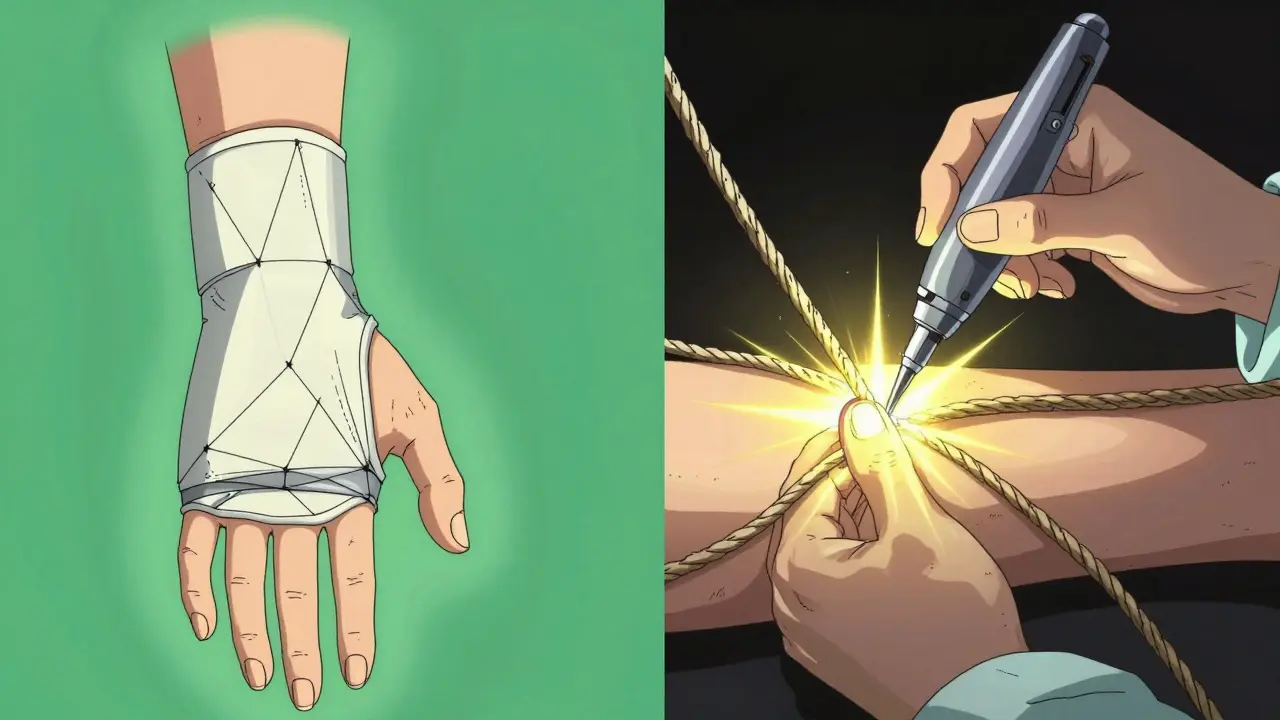
Surgical Intervention: When to Consider Carpal Tunnel Release
Surgery is recommended if you have severe symptoms, such as muscle weakness or atrophy, or if conservative treatments fail after 6-8 weeks. The goal of Carpal Tunnel Release Surgery is to cut the transverse carpal ligament to decompress the median nerve.
There are two main approaches:
- Open Release: The surgeon makes a 2-3 inch incision in your palm. This is the traditional method with a long track record. It provides a clear view of the anatomy, reducing the risk of nerve injury.
- Endoscopic Release: Using a tiny camera and specialized tools, the surgeon makes one or two smaller incisions. Recovery might be slightly faster (2-3 weeks less), and there is less scar tissue. However, it costs 15-20% more and has a steeper learning curve for surgeons.
Both methods have a 90-95% success rate. Most patients return to light work in 2-3 weeks and full duty in 6-8 weeks. Be aware of "pillar pain," a soreness in the palm that affects 15-30% of patients during recovery. It usually resolves within a few months.
Innovations continue to emerge. The FDA approved the Sonex Health SX-One MicroKnife in 2021, an ultrasound-guided device that performs a percutaneous release. Early data suggests it causes 40% less postoperative pain and allows a 50% faster return to work compared to traditional methods.
Prevention and Lifestyle Adjustments
You cannot change your genetics, but you can control your environment. Ergonomics plays a huge role in preventing CTS or stopping it from worsening.
- Adjust Your Workspace: Keep your wrists straight when typing. Use a keyboard tray or a split keyboard if necessary. Avoid resting your wrists on a hard edge for hours.
- Take Breaks: Follow the 20-20-20 rule for your hands. Every 20 minutes, take a 20-second break to stretch your hands and wrists.
- Avoid Extreme Positions: Try to keep your wrist between -30 and +30 degrees of flexion/extension during repetitive tasks. Holding a tool or mouse with a sharply bent wrist dramatically increases carpal tunnel pressure.
If you work in high-risk industries like manufacturing, healthcare, or food service, advocate for ergonomic assessments. In the EU, mandatory ergonomic reviews are required for high-risk jobs. In the US, OSHA provides guidelines, but implementation varies. Protecting your nerves is worth the effort.
How long does it take to recover from carpal tunnel surgery?
Most patients return to light-duty work within 2-3 weeks. Full recovery, including regaining maximum grip strength, typically takes 6-8 weeks. Those in manual labor jobs may need 10-12 weeks of modified duty. Postoperative physical therapy often consists of 6-8 sessions over this period.
Can carpal tunnel syndrome go away on its own?
Mild cases may improve with rest and activity modification, but true structural compression rarely resolves completely without intervention. Ignoring symptoms can lead to permanent nerve damage. Early treatment with splinting has a 75% success rate for preventing progression.
Is endoscopic surgery better than open surgery?
Both techniques have similar long-term success rates (90-95%). Endoscopic surgery may offer a faster return to work and less scar pain initially, but it is more expensive and carries a slightly higher risk of incomplete release or nerve injury if performed by less experienced surgeons. Open surgery remains the gold standard for reliability.
What foods help with carpal tunnel syndrome?
While no specific diet cures CTS, anti-inflammatory diets rich in omega-3 fatty acids (found in fish, flaxseeds) and vitamins B6 and B12 may support nerve health. Maintaining a healthy weight also reduces systemic inflammation, which can exacerbate nerve compression.
Does diabetes increase the risk of carpal tunnel syndrome?
Yes. Diabetes can cause peripheral neuropathy and make nerves more susceptible to compression injuries. People with diabetes should monitor their hand symptoms closely and seek early evaluation if numbness begins, as their threshold for surgical intervention may be lower to prevent permanent damage.