
Many older adults struggle to understand medical information-even when it’s meant to help them. A 2023 CDC report found that 63% of seniors have trouble reading medication labels, and over half don’t ask questions when they’re confused, not because they don’t care, but because they’re embarrassed. The truth is, most hospital pamphlets, website articles, and even doctor’s instructions are written for people who read at a 7th or 8th grade level. But the average older adult reads at a 3rd to 5th grade level. That gap isn’t about intelligence. It’s about design.
Why Standard Health Materials Don’t Work for Seniors
It’s not just about big print. Older adults face real, physical changes that make standard health materials hard to use. Vision gets weaker-many need reading glasses, and even then, small fonts blur. Hearing fades, making it harder to catch details during appointments. Memory doesn’t work like it used to. A list of five new medications? That’s overwhelming. A paragraph explaining how to use an inhaler? Too dense.
Research from the National Institute on Aging shows that 71% of adults over 60 have trouble reading basic health print. Eighty percent struggle with forms, charts, or instructions that involve numbers. That’s not a small number. That’s most of them. And when people don’t understand what they’re supposed to do, they skip doses, skip appointments, or end up in the ER.
A 2021 study in the Journal of General Internal Medicine found that when materials were rewritten for a 3rd to 5th grade reading level, seniors understood the content 42% better. That’s not a slight improvement. That’s life-changing.
What Makes a Good Senior Patient Education Material
Good materials don’t just simplify words-they rethink how information is delivered. The National Institute on Aging and the American Geriatrics Society agree on key standards:
- Font size: At least 14-point, preferably 16-point. Avoid fancy fonts like Script or Comic Sans. Use Arial, Helvetica, or Verdana-they’re clear and easy to read.
- Contrast: Black text on white paper works best. Avoid light gray text or colored backgrounds.
- Layout: One idea per page. Short paragraphs. Lots of white space. Bullet points, not walls of text.
- Images: Simple drawings, not photos. A drawing of a hand holding a pill bottle with arrows showing when to take it is clearer than a paragraph about “dosing schedules.”
- Numbers: Use words instead of digits when possible. Say “three pills” instead of “3 pills.” Avoid complex math. Don’t say “take every 8 hours”-say “take at breakfast, dinner, and bedtime.”
- Context: Explain similar-looking letters and numbers. For example, “m as in Mary” to avoid confusion with “rn.”
Materials should also be tested with real seniors-not just family members or caregivers. The HealthPartners Institute says each resource needs 5 to 7 rounds of testing with at least 15 older adults before it’s finalized. That’s not extra work. That’s how you know it actually works.
How to Use the Teach-Back Method
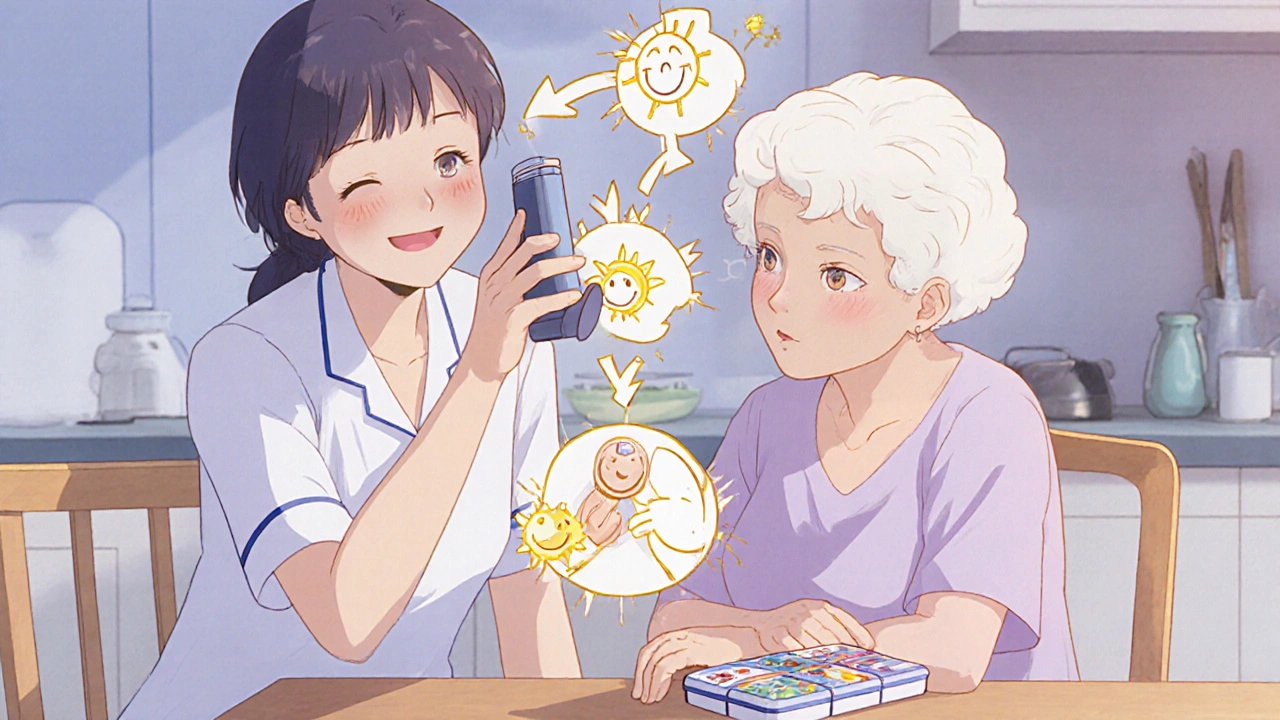
Doctors and nurses can’t just hand out a sheet and assume it’s understood. The most powerful tool in senior education is called the “teach-back” method. It’s simple: after explaining something, ask the patient to explain it back in their own words.
Instead of saying, “Do you understand?”-which often leads to a polite “yes”-say: “Can you tell me how you’ll take this medicine each day?” or “Show me how you’d use this inhaler.”
A 2022 study in Patient Education and Counseling found that providers who used teach-back spent just 2.7 extra minutes per visit-but saw a 31% boost in patient understanding. That’s a tiny time investment for huge results.
And it’s not just for doctors. Caregivers can use it too. If you’re helping a parent manage diabetes, ask: “What do you do when your sugar is high?” Their answer tells you if the instructions stuck.
Where to Find Reliable, Easy-to-Read Materials
Not all websites are created equal. Here are trusted sources that follow strict health literacy guidelines:
- HealthinAging.org-run by the American Geriatrics Society. Offers over 1,300 free, plain-language handouts on topics like falls, memory, and heart disease. All reviewed by older adults.
- MedlinePlus-from the National Library of Medicine. Has a dedicated “Easy-to-Read Health Information” section with 217 resources, from Alzheimer’s to healthy eating. Each one is labeled with the Health Education Materials Assessment Tool (HEMAT) score.
- National Institute on Aging (NIA)-their “Talking With Your Older Patients” guide is used by clinics nationwide. Their Go4Life program includes simple exercise videos with voiceovers and step-by-step visuals.
- CDC’s Healthy Aging Program-their 2023 guidelines include printable fact sheets on flu shots, vaccines, and managing multiple conditions.
These aren’t just websites. They’re toolkits. They offer materials in multiple formats: printable PDFs, audio files, video demonstrations, and even large-print versions. And they’re free.
Technology Can Help-If It’s Designed Right
Telehealth is now used by 68% of older adults, up from just 17% in 2019. But many apps and portals are still designed for tech-savvy users. Buttons are too small. Menus are confusing. Text is too light.
The good news? Tools are improving. In January 2024, the NIA updated its Go4Life app to include voice commands: “Tell me how to do the chair stand.” No typing needed. HealthinAging.org added new resources in 2023 specifically for seniors with mild memory loss-using repetition, slow pacing, and visual cues.
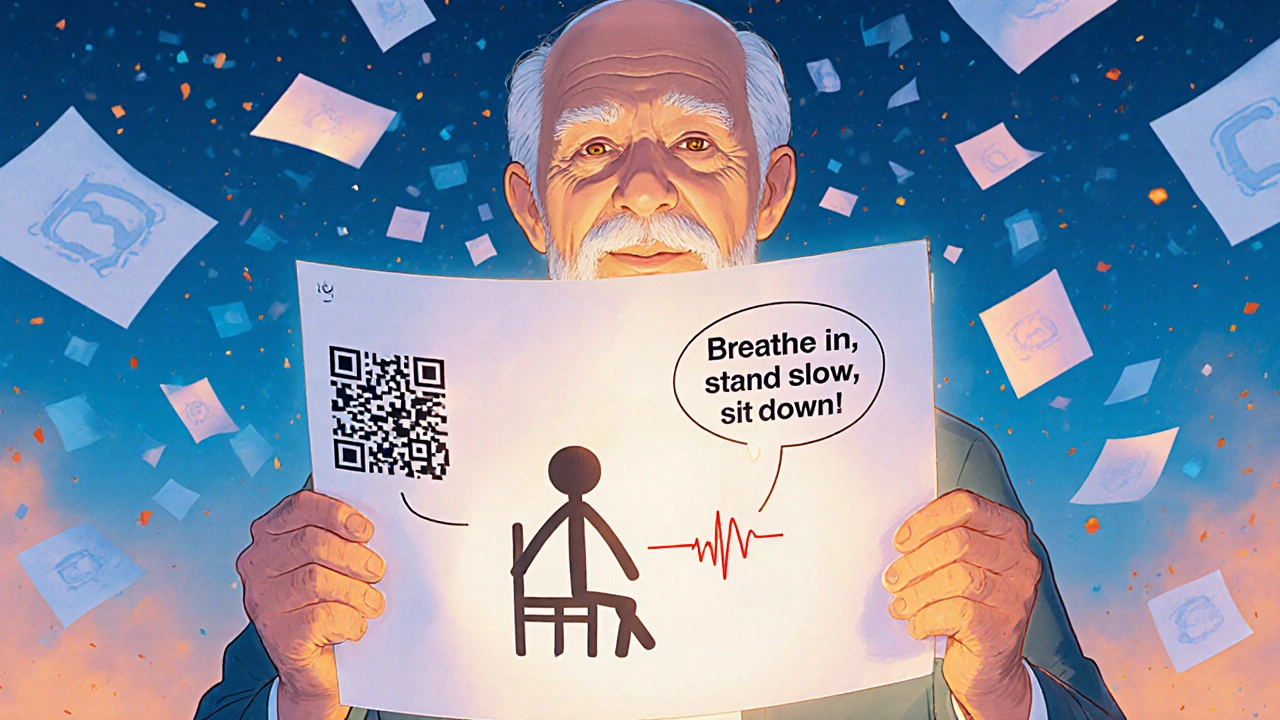
But technology isn’t a fix-all. Many seniors still prefer paper. A 2023 survey found that 61% of seniors over 75 say they trust printed materials more than apps. So the best approach? Combine both. Give them a printed guide and a QR code that links to a video explanation.
Why This Matters Beyond the Clinic
When seniors understand their care, the results are clear. Hospitals that use universal health literacy practices see 22% fewer emergency visits. Medicare patients who get clear education have 14.3% fewer readmissions. That’s not just better health-it’s savings. The Centers for Medicare & Medicaid Services estimate that each avoided readmission saves $1,842 per person.
And it’s not just about cost. It’s about dignity. When someone understands their treatment, they feel more in control. Less scared. Less alone.
Yet, only 28% of U.S. healthcare systems fully use these best practices. Most still rely on generic brochures printed in 8-point font. That’s not negligence. It’s habit. And habits can change.
What You Can Do Today
If you’re a senior, a caregiver, or a family member:
- Ask for materials in large print or audio format. You have the right to ask.
- Use the teach-back method after every appointment. Say: “Can you explain this back to me so I’m sure I got it right?”
- Visit HealthinAging.org or MedlinePlus. Bookmark them. Print out what you need.
- If you’re helping someone manage meds, use a pill organizer with pictures. Label each slot with a photo of the pill and the time of day.
- Don’t assume they understand just because they nod. Ask open questions. Listen.
If you’re a provider or caregiver in a clinic:
- Replace all standard brochures with plain-language versions from trusted sources.
- Train staff in teach-back. Even 30 minutes of training makes a difference.
- Test your materials with real seniors before rolling them out.
- Keep printed copies available-even if you use electronic records.
What’s Next for Senior Patient Education
The future is personal. The National Institutes of Health is funding a $4.2 million project to build AI tools that adapt educational content based on a person’s vision, hearing, and memory. Imagine a handout that changes font size automatically-or a video that slows down if the user looks confused.
By 2026, all medical students in the U.S. will need 8 hours of health literacy training. Medicare spending on these programs will jump from $187 million in 2023 to $312 million by 2027.
Change is coming. But it doesn’t wait for policy. It starts with one person asking, “Can you say that again?” and one provider taking the time to explain it clearly.
What reading level should senior patient education materials be written at?
Materials should be written at a 3rd to 5th grade reading level. This matches the average reading ability of older adults, especially those with limited health literacy. Even though the national average is 7th to 8th grade, research shows seniors understand information far better when it’s simplified. The National Institute on Aging and CDC both recommend this level for maximum clarity.
Why do seniors often not ask questions during doctor visits?
Many seniors don’t ask questions because they feel embarrassed or fear being seen as unintelligent. A 2022 National Council on Aging survey found that 51% of older adults admit to staying silent when confused. They may think the information is too complicated for them, or they don’t want to waste the doctor’s time. Creating a welcoming, patient-centered environment helps reduce this fear.
Are digital health tools helpful for older adults?
They can be-but only if designed for seniors. Many apps and portals use small buttons, fast menus, and complex language that confuse older users. The best digital tools combine voice commands, large text, simple navigation, and video instructions. The NIA’s updated Go4Life app and HealthinAging.org’s video guides are good examples. Always offer printed backups, since many seniors still prefer paper.
How can caregivers help seniors understand their medications?
Use a pill organizer with pictures labeled by time of day (morning, afternoon, bedtime). Write down each medication’s purpose in simple words: “This is for your blood pressure,” not “This is an ACE inhibitor.” Review the list together weekly. Use the teach-back method: ask the senior to explain how and when to take each pill. If they can’t, go back and simplify further.
Where can I find free, easy-to-read health materials for seniors?
Start with HealthinAging.org (run by the American Geriatrics Society), MedlinePlus.gov (from the National Library of Medicine), and the National Institute on Aging’s website. All offer free, downloadable handouts, videos, and large-print guides on common senior health topics like diabetes, heart disease, falls prevention, and dementia. These resources are tested with older adults and follow federal plain language standards.